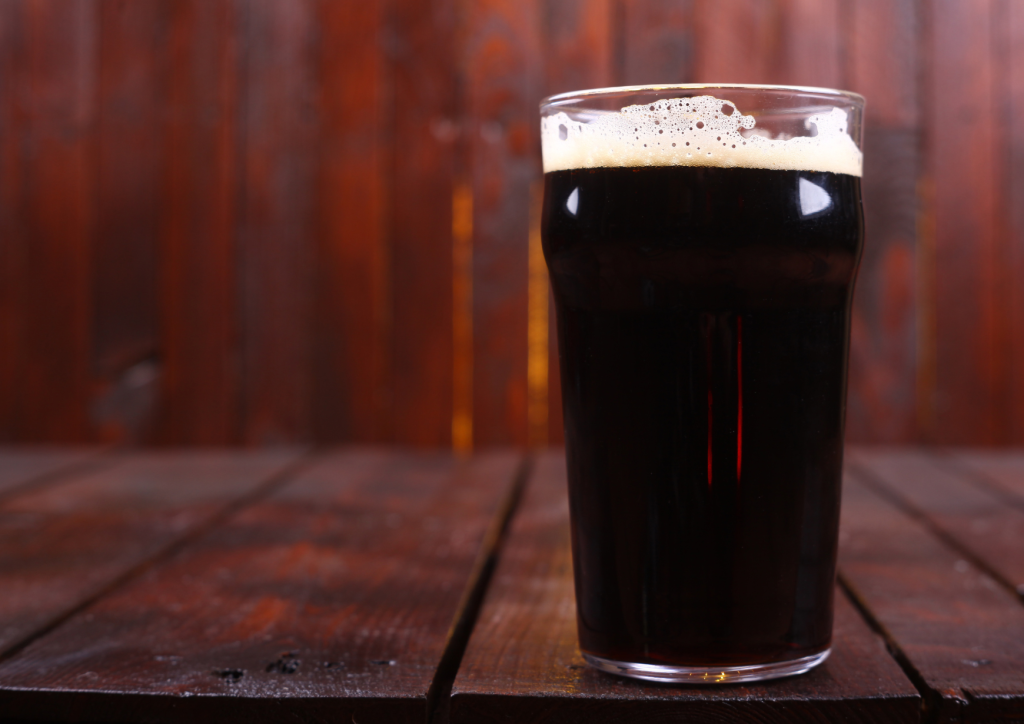
American Stout Recipe :
- Color : Deep brown to ruby black (65 EBC)
- Alcohol : 6.7%
- Volume : 20L
- Bitterness : Noticeable (40 IBU)
- Brew time : 5h
- Difficulty : Medium
Ingredients :
Grains :
- 2.5kg of Extra pale premium pilsner malt
- 1.5kg of Munich 15 malt
- 1kg of Rye malt
- 0.36kg of Chocorye
- 0.36kg of Roasted Barley
Hops, sugar and licorice :
- 0.3kg of brown candi sugar (Boil – 90 minutes)
- 20g of Centennial hops (Boil – 90 minutes)
- 25g of Cascade hops (Boil- 20min)
- 10g of Licorice roots (Boil – 15min)
- 15g of Centennial hops (Boil – 5min)
- 25g of Cascade hops (Boil- – 5min)
Yeast & brewing water :
- 2 packets of Lallemand House Ale yeast
- Total water volume : 35.5L
- Sulfate/Chloride ratio : 3/2
- Mash pH : 5.4
- Ideal sparge water pH : 5.6
Brew our American Stout recipe step by step :
Step 1 :
Pour 19 liters of water into your kettle and set the heat to 72°C.
Add your grains and stir thoroughly to prevent clumping. Continue until the temperature drops to 68°C.
Hold this temperature for 60 minutes.
Optional : you can use around 200g of rice hulls to help with filtration. Meanwhile, heat 16.5 liters of water to 77°C.
Once the saccharification rest is complete, raise the temperature to 75°C for a 10-minute mash-out.
Step 2 :
Once the mash-out is complete, proceed with lautering and sparging.
Step 3 :
Heat your kettle to begin the boil.
You can add the sugar now and stir well to help it dissolve.
As soon as the first bubbles appear, add 20g of Centennial hops and start a 90-minute timer.
With 20 minutes remaining, add 25g of Cascade hops.
Five minutes later, incorporate 10g of licorice root. If you’re using a cooling coil, don’t forget to sterilize it in the wort at this point.
Finally, with 5 minutes left, complete the hopping with 25g of Cascade and 15g of Centennial.
Step 4 :
Once the boil is complete, cool your wort down to 19°C.
Take a gravity reading — it should be around 1.063 — then transfer the wort to your fermenter.
Step 5 :
Ferment for 3 weeks at 19°C, then raise the temperature to 21°C for another 2 weeks.
Final gravity should be around 1.012. If you’re equipped, perform a cold crash (3 days at 3–5°C).
You can also consider a two-week cold conditioning — malt-forward styles benefit from it, though it’s optional.
Ideally, use a pressure-capable fermenter. That way, you can carbonate to 2.3 volumes of CO₂ and serve directly.
Otherwise, proceed with classic bottling and prime with 5g/L of sugar
Conclusion :
Stouts offer an almost limitless canvas for expression. This style invites exploration of malt combinations, unexpected ingredients, and rich aromatic profiles — all while maintaining a solid structure. Our American Stout recipe embraces this spirit of experimentation, with a distinctly bold US approach.
The hop character, driven by Cascade and Centennial, delivers assertive bitterness with citrusy and floral notes. But it’s the licorice that plays a key role: it adds a woody, subtly resinous dimension that evokes the conifer forests of the American Northwest — a unique and well-integrated aromatic signature.
A long boil intensifies the malt aromas, develops caramelized notes, and encourages a harmonious fusion of ingredients. Rye contributes a spicy touch and a distinctive texture, while roasted malts are present without overpowering, striking a balance between smoothness and dryness.
With its 6.7% ABV and a fairly neutral fermentation profile, this stout combines comfort, strength, balance — and serious drinkability.