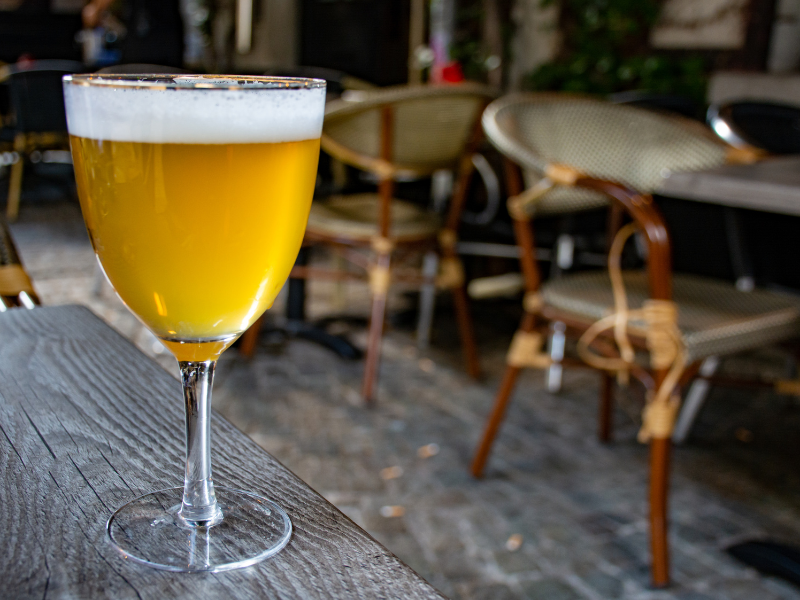
Belgian single recipe :
- Color : Blonde to golden
- Alcohol : 5.9%
- Quantity : 20L
- Bitterness : Noticeable (38 IBU)
- Brewing time : 5h
- Difficulty : Easy
Ingredients :
Grains :
- 4.5kg of Pilsen Malt
- 0.25kg of Biscuit Malt
Hops and Sugar :
- 250g of white candi sugar (Boil – 60 minutes)
- 50g of Hallertau Mittelfrüh hops (Boil – 60 minutes)
- 40g of Hallertau Mittelfrüh hops (Boil – 15 minutes)
- 40g of Styrian Goldings hops (Boil – 5 minutes)
Yeast and Brewing Water :
- 2 packets of Lallemand Abbaye yeast
- Total water volume : 32L
- Chloride/Sulfate ratio : 1/1
- Mash pH : 5.3
- Ideal sparge water pH : 6
Brew our belgian single recipe step by step :
Step 1 :
Pour this 16 liters of water into your kettle and set the heating to 70°C.
Add your grains and stir thoroughly to avoid clumps. Continue until the temperature drops to 66°C.
Hold it there for 75 minutes. It’s a bit long, but ideal for producing a highly fermentable wort.
Meanwhile, heat 16 liters of water to 77°C.
Once saccharification is complete, raise the temperature to 75°C for a 10-minute Mash-Out.
Step 2 :
Once the Mash-Out is done, proceed with lautering and sparging.
Step 3 :
Heat your kettle to begin the boil. You can add the sugar now and stir well to help it dissolve.
As soon as the first bubbles appear, add 50g of Hallertau Mittelfrüh and start a 60-minute timer.
15 minutes before the end, add 40g of Mittelfrüh. If you’re using a cooling coil, don’t forget to sterilize it in the wort at this point. For better clarity, you can also add 5g of Irish moss.
Finally, with 5 minutes remaining, finish the hopping with 40g of Styrian Goldings.
Step 4 :
Once the time is up, cool your wort down to 19°C.
Take the gravity reading, which should be around 1.054, and transfer the wort to the fermenter.
Step 5 :
Ferment for 5 weeks at 20°C, then raise the temperature to 22°C for a few more days. The final gravity should be around 1.009.
If you have the equipment, perform a cold crash (3 days at 3–5°C).
Ideally, use a pressure-capable fermenter. That way, you can carbonate to 2.6 volumes of CO₂ (or even 2.75 for the adventurous) and serve the beer directly.
Otherwise, go for classic bottling by priming with 7g/L of sugar. You can increase to 8g/L if you enjoy a bit more fizz—this style handles it well.
Conclusion :
This beer belongs to the Abbey Singel tradition—an uncommon style often mistaken for Belgian Blonde or Belgian Pale Ale. Yet Singels have their own identity: a light body, expressive fermentation, and a more prominent role for hops.
In terms of drinkability, it’s close to a German pilsner, and its aromatic profile almost earns it the nickname “Session Tripel.”
With 5.9% ABV and 38 IBU, this Belgian Single recipe echoes the character of Westvleteren 6 : dry, fruity, and crisp. Like many Belgian styles, it’s built on simplicity, allowing the ingredients to shine. A base of pilsner malt is complemented by a touch of biscuit malt and a small dose of candi sugar, which helps dry out the beer and lighten its body.
Hops play a starring role too. The Mittelfrüh and Styrian Goldings combo pairs beautifully with the yeast’s floral and spicy expression. The result ? A clear, crushable, and surprisingly aromatic beer—crafted purely for enjoyment.