In the world of sour beers, Kettle Sour remains the dominant method. This technique delivers a clean, crisp lactic acidity that is highly consistent and repeatable.
However, it presents certain limitations within a microbrewery production schedule. Tying up the brew kettle for 24 to 48 hours is costly. Maintaining the wort at temperature requires significant energy, and managing the risk of introducing lactic acid bacteria into the brewery represents a major operational constraint on a day-to-day basis.
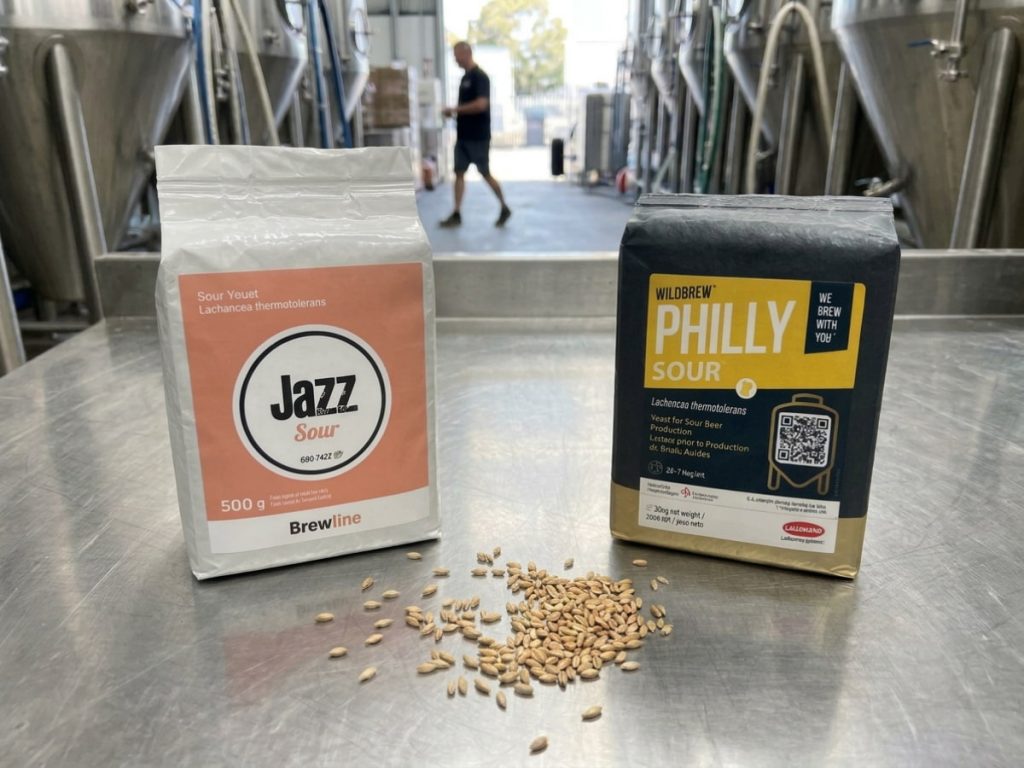
Today, breweries have access to a biological alternative: the yeast strain Lachancea thermotolerans (e.g. Philly Sour, Jazz). Long viewed with caution due to mixed feedback regarding its flavour profile, this non-Saccharomyces yeast nevertheless proves to be a highly effective production tool when properly managed.
Where does Lachancea thermotolerans come from?
Formerly known as Kluyveromyces thermotolerans, this non-Saccharomyces yeast is naturally found on the skins of grapes and in grape musts during winemaking. In the wine industry, it has been valued for years for its ability to rebalance acidity in wines produced in warm climates through the natural production of L-lactic acid.
Its unique metabolic profile quickly attracted the attention of brewing researchers. Capable of producing lactic acid while simultaneously carrying out fermentation (up to a certain alcohol level), it was isolated to provide brewers with a novel biological alternative: acidifying wort directly in the fermenter, without the use of lactic acid bacteria (Lactobacillus) and without tying up the brewhouse.
Lachancea vs. Saccharomyces
A traditional Saccharomyces strain converts sugars into ethanol and CO₂. By contrast, Lachancea thermotolerans redirects part of the glucose and fructose toward the production of L-lactic acid.
- Sugar requirements: Acid production depends directly on the simple sugars available at the start of fermentation. A wort with a higher initial glucose content will produce more acid.
- The brewer’s trick: Add 1 to 2% dextrose (or another simple sugar) relative to the total grain bill, directly at the end of the boil. This supply of readily fermentable sugars kick-starts acidification during the first few hours in the fermenter.
Once the target pH is reached (typically between 3.2 and 3.8), acid production naturally stops. If used on its own, the alcoholic fermentation then proceeds normally.
Temperature and Pitching Rate
Lachancea thermotolerans requires warm fermentation conditions to fully express its acid-producing potential. Do not restrict it to 18-20°C as you would with a traditional ale yeast.
- Ideal pitching temperature: Pitch your cooled wort at 27-28°C (81-82°F). This higher temperature range maximizes the conversion of sugars into lactic acid.
- Pitching rate: Use 50-100 g/hL for a standard wort (<14°P). Increase the dosage to 100-150 g/hL for higher-gravity worts (>14°P) or more complex beer profiles to avoid metabolic stress on the yeast.
- Acidification timeline: The active acid production phase occurs during the first 24 to 48 hours of fermentation. Maintain this temperature range throughout this period to maximize acidification.
Demystifying the Flavor Profile of Lachancea thermotolerans
Lachancea thermotolerans is sometimes criticized for producing unusual or vegetal flavor notes. In reality, these characteristics are generally the result of metabolic stress rather than an inherent flaw of the strain itself.
Lachancea has a high demand for yeast assimilable nitrogen (YAN) and micronutrients. A nutrient-deficient wort can lead to the formation of undesirable fermentation by-products.
💡Pro tip: Add a zinc-rich nutrient such as Lallemand Servomyces at pitching. It helps support enzymatic activity and reduces the risk of flavor deviations.
With proper nutrition and careful temperature management, Lachancea produces a clean acidity complemented by elegant citrus and orchard fruit notes.
Inoculation Protocols in the Brewery
Several approaches can be used to control acidification and attenuation depending on your production requirements:
- Sequential Pitching (Recommended): Pitch Lachancea thermotolerans on its own at 27-28°C (81-82°F). Wait until the target pH is reached (typically within 24 to 48 hours). Then lower the fermentation temperature to 18-22°C (64-72°F) and pitch a neutral finishing strain (US-05, K-97, or equivalent) to ferment the remaining maltose.
- Simultaneous Co-Pitching: Pitch Lachancea and your Saccharomyces strain together from the start at 27-28°C (81-82°F). After 48 hours, reduce the temperature setpoint to 20°C (68°F). This method offers less precise control over the final pH but is ideal for saving fermentation cellar time.
How to Control Acidity
The intensity of acidification depends on the amount of simple sugars (glucose and fructose) consumed during the first 24 to 48 hours. The strain typically produces between 3 and 5 g/L of L-lactic acid, lowering the pH to a range of approximately 3.2 to 3.8.
- Monitoring equipment: Don’t rely on timing alone. Track the acidification curve using a calibrated pH meter, starting 12 hours after pitching, with measurements taken every 6 to 12 hours.
- How to stop acidification at the target pH: If the desired pH is reached before the strain has completed its activity, lower the fermenter temperature below 18-20°C (64-68°F) or pitch a finishing Saccharomyces strain. Sugar competition and the lower temperature will halt lactic acid production.
Can You Use 100% Lachancea thermotolerans? Possible or Not Recommended?
Many of the flavor-related criticisms aimed at Lachancea thermotolerans stem from poorly managed single-strain fermentations. Yet a 100% Lachancea fermentation is entirely feasible under the right conditions.
- When it works well (low-ABV beers): For a light Berliner Weisse (3.5-4% ABV), single-strain fermentation performs very well. The lower original gravity places less stress on the yeast, making fermentation easier to manage.
- The limitations at higher gravities: For beers with higher alcohol content or larger amounts of unfermentable sugars (Pastry Sour, Sour IPA, etc.), single-strain fermentation presents two major challenges:
- Incomplete attenuation: The yeast has a limited ability to ferment maltotriose. Fermentation may stop prematurely, leading to off-flavors and leaving the beer overly full-bodied and sweet.
- Alcohol sensitivity: Its alcohol tolerance is quickly reached beyond approximately 5-6% ABV.
- Incomplete attenuation: The yeast has a limited ability to ferment maltotriose. Fermentation may stop prematurely, leading to off-flavors and leaving the beer overly full-bodied and sweet.
💡Also on the blog: Dip Hopping: How to Enhance Your Hop Aroma ? Extract cleaner hop aromas and reduce vegetal off-flavors from the moment the fermenter is filled.
Kettle Sour vs direct pitch
| Parameter | Traditional Kettle Sour | Direct Fermentation (Lachancea) |
|---|---|---|
| Brew Kettle Occupancy | Occupied for 24–48 h | No downtime (direct transfer) |
| Energy Consumption | High (held at 38–45°C / 100–113°F) | None (temperature peak managed in the fermenter) |
| Microbiological Safety | Risk of cross-contamination with other beers (Lactobacillus) | None (pure yeast culture, no bacteria) |
| Bitterness Tolerance | Very low (< 5–8 IBU) | High (can tolerate 15–20 IBU during brewing) |
⚠️ Process Warning: Lachancea thermotolerans is more tolerant of kettle hopping than lactic acid bacteria. However, bitterness should still be kept below 15-20 IBU to preserve the freshness and brightness of the acidity.
💡 Also on the blog: CIP: Cleaning: Everything You Need to Know to Get Started Right. Managing co-fermentations requires rigorous sanitation practices. Review the fundamentals of clean-in-place (CIP) cleaning to ensure consistent results.
FAQ: Lachancea thermotolerans in Brewing
What is Lachancea thermotolerans?
Lachancea thermotolerans is a non-Saccharomyces yeast capable of producing both alcohol and lactic acid during fermentation. It allows brewers to create sour beers without the use of lactic acid bacteria.
What is the difference between Kettle Sour and fermentation with Lachancea thermotolerans (Philly Sour, Jazz)?
Kettle Sour relies on acidifying the wort with lactic acid bacteria before the boil. With a Lachancea thermotolerans strain such as Philly Sour or Jazz, acidification occurs directly in the fermenter during alcoholic fermentation.
What pH can Lachancea thermotolerans achieve?
Depending on the recipe, pitching rate, fermentation temperature, and the availability of simple sugars, Philly Sour typically reaches a pH between 3.2 and 3.8.
As a guideline:
- pH 3.8: light and refreshing acidity
- pH 3.5: pronounced acidity
- pH 3.2: bright, intense acidity
Can Philly Sour or Jazz be used on their own?
Yes. A 100% Lachancea thermotolerans fermentation works well for lighter beers such as Berliner Weisse.
For stronger beers or recipes with higher levels of residual sugars, many brewers prefer a sequential fermentation approach using a Saccharomyces strain to improve final attenuation.
What fermentation temperature is best for Lachancea thermotolerans?
A fermentation temperature between 26°C and 28°C (79-82°F) is ideal for producing a clean, well-defined acidity.
Optimize Your Acidification with the Right Brewing Inputs
Ensure consistent results in your sour beer production with these essential products from our professional catalogue:
- Lallemand WildBrew Philly Sour Dry Yeast (500 g): The benchmark Lachancea thermotolerans strain. It delivers clean acidity and a very crisp fruit-forward profile.
- Brewline Jazz Sour Dry Yeast (500 g): An excellent professional alternative from Brewline. It offers highly consistent acidification performance on larger production volumes.
- Lallemand Servomyces Yeast Nutrient (500 g): The ideal biological nutrient to boost yeast health with zinc and help prevent metabolic stress.
- Recommended protocol: Combine a simple sugar addition at the end of the boil (1-2%), a dose of Servomyces, and a pitching temperature of 27-28°C (81-82°F) for optimal acidification performance.
In Summary
While Kettle Sour remains the benchmark approach for sour beer production, direct fermentation with Lachancea thermotolerans is emerging as a modern, cost-effective, and reliable alternative.
Whether used as a single culture in low-ABV beers or in a sequential fermentation process for higher-gravity recipes, this strain can save valuable production time, reduce contamination risks, and lower energy consumption.
Expand your sour beer portfolio with greater consistency and efficiency!
Need help optimizing your nutrient additions?
👉 Browse our yeast and nutrient catalogue for professional breweries.
👉 Contact our team for advice or a quote: [email protected]