
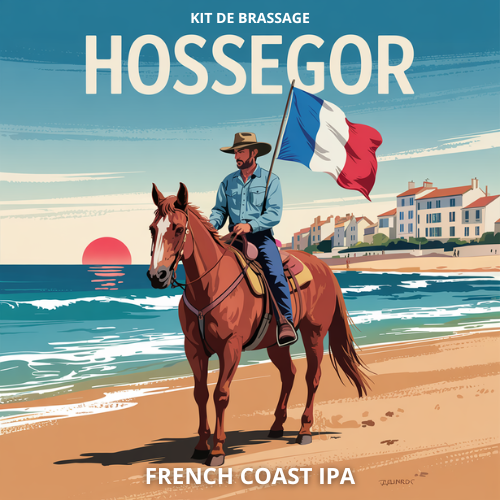
Recipe for French Coast IPA :
French Days 2025 : Limited edition kit from April 30 to May 06 only.
This recipe revisits the West Coast IPA “Rive Gauche” with a French twist. Specially redesigned for French Days, it features products made exclusively in France and/or by French manufacturers.
- Color : Straw yellow (16 EBC)
- Alcohol content : 7%.
- Quantity : 20L
- Bitterness : 58 IBU
Ingredients :
Malted base
- 5kg of Pale Ale Malt – Soufflet
- 300g of Carapilsen Malt – Soufflet
- 300g of Munich 25 Malt – Soufflet
Hot-Side hopping
- 30g of Aramis hops (First Wort)
- 25g of Mistral hops (Boiling : 10 minutes)
- 25g of Triskel hops (Boiling : 10 minutes)
Off-flame” hopping
- 25g of Elixir hops (90°C – 20 minutes)
- 30g of Triskel hops (90°C – 20 minutes)
- 30g of Mistral hops (90°C – 20 minutes)
Dry-Hop
1st Dry-Hop 3g/L – 24h after seeding
- 20g of Mistral hops
- 20g of Triskel hops
- 20g of Elixir hops
2nd Dry-Hop 4gL – 3 days before bottling
- 20g of Mistral hops
- 20g of Triskel hops
- 20g of Elixir hops
Yeast and water
- 2 packets of US-05 Yeast – Fermentis
- Total water volume: 32L. Preferably Sulfate > Chloride (ideally 4:1, if this is impossible, minimum 2:1) Ideal potting pH: 5.3
Brew our French Coast IPA recipe step by step
Step 1
In your brewing kettle, heat 15.3 liters of water to 73.2°C, then add the crushed grains. Stir thoroughly to soak the malt well and crush any lumps against the sides of the kettle if necessary. Continue stirring until the temperature reaches 66°C, then maintain this temperature for 1 hour. Meanwhile, heat 16.9 liters of water to 75°C for rinsing.
Step 2
Once saccharification is complete, proceed with filtration and rinsing. Add 30g of Aramis hops at the start of filtration.
Step 3
Next, heat the wort for a 60-minute boil. At 10 minutes before the end, add 25g of Mistral hops and 25g of Triskel hops.
Step 4
When the boil is complete, reduce the temperature to 90°C and add the flameout hops: 25g of Elixir, 30g of Triskel, and 30g of Mistral. Let them steep for 20 minutes before cooling.
Step 5
When the temperature reaches 18°C, measure the density (approximately 1.061) and transfer the wort into a fermenter. Add the yeast, then maintain at 18°C for 4 weeks.
Step 6
24 hours after pitching the yeast, perform the first dry hop with 20g of Mistral, 20g of Triskel, and 20g of Elixir. While this beer is not a NEIPA, the significant hop addition makes it sensitive to oxidation. If you don’t have a CO2 system, it’s recommended to leave the hops throughout fermentation. This may result in slight hop burn, but it’s minimal and preferable to oxidation.
Step 7
During the last week of fermentation, increase the temperature to 22°C. Three days before bottling, perform a second dry hop with 20g of Mistral, 20g of Triskel, and 20g of Elixir. If possible, place the fermenter in the refrigerator to reach about 1°C during this period. If not feasible, don’t worry—it’s a secondary optimization. At the end, the final density should be around 1.013.
Step 8
At bottling, add 5g of sugar per liter or perform forced carbonation to 2.5 volumes of CO2.
French Days 2025 : Limited edition kit from April 30 to May 06 only.